
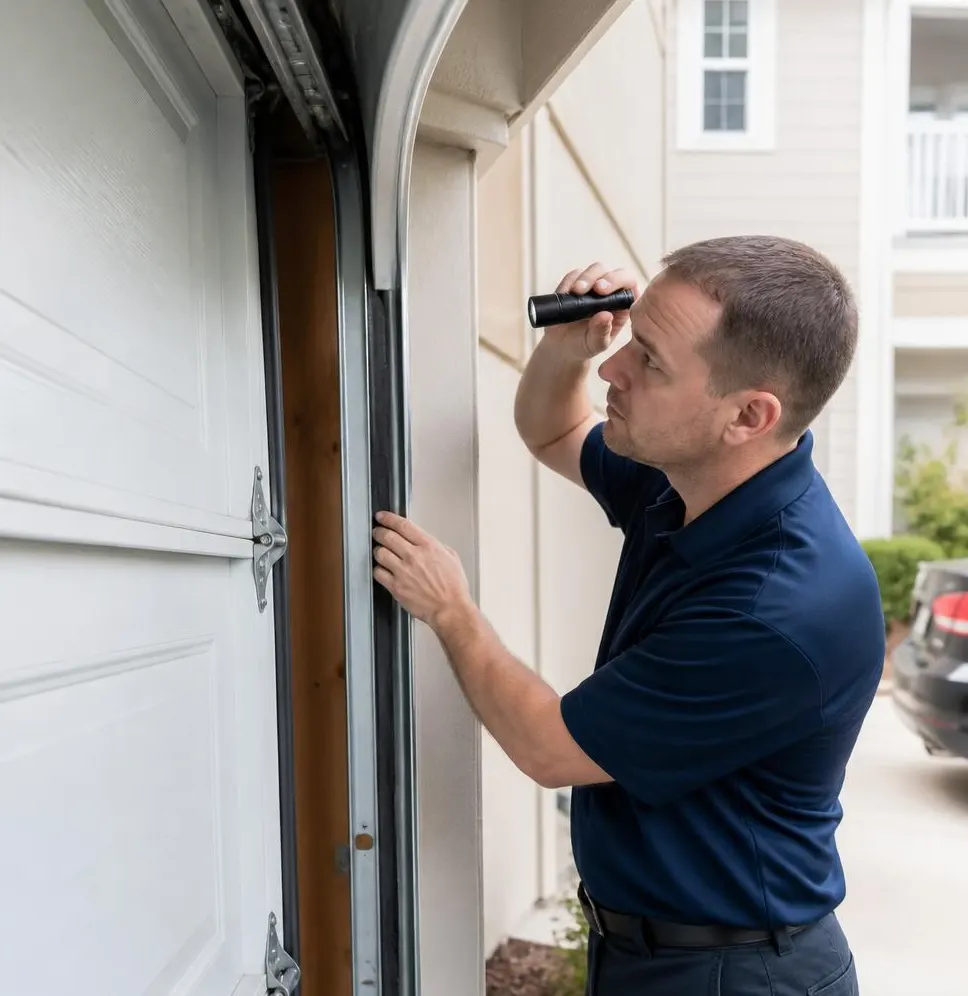
The Moment You Notice It
You hit the button, watch the door roll down, and right before it reaches the floor it stops, shudders, and climbs back up to open — on its own, every single time. Or maybe it never gets that far: you press close, the opener motor hums, the door doesn't budge, and the wall control light just blinks at you. Either way, you're standing in your driveway at dusk wondering if you need a new door or just a new battery.
Neither guess is usually right. This is one of the most common calls we get, and it's rarely random. The door is doing exactly what it's built to do — refuse to close — because something is telling it the path isn't clear or the resistance is wrong. The question is what, and a technician checks that in a specific order.
What You're Actually Seeing
- Reverses a few inches above the floor — classic safety sensor issue.
- Reverses partway down, inconsistently — often a track or roller problem.
- Won't move at all when you press close — could be the opener's travel limits, a dead sensor circuit, or a spring that's lost so much tension the opener won't fight it.
- Closes fine from the wall button but not the remote, or vice versa — usually points to the sensors or wiring, not the door itself.
Where a Technician Starts Looking
1. The Safety Sensors (Photo Eyes)
These are the two small eyes mounted a few inches off the floor on either side of the track. If they're misaligned, dirty, or one is staring into bright afternoon sun, the opener assumes something is blocking the door and reverses it as a safety measure. In this area, salt air and humidity speed up the grime buildup on the lenses, and low afternoon sun during storm season can wash out the beam entirely. The fix: wipe both lenses clean, check that the indicator lights on each sensor are solid (not blinking), and nudge the brackets until they line up straight across the opening. This is a five-minute check and solves a large share of these calls.
2. Sensor Wiring and Connections
If the lenses are clean and aligned but the light still blinks, the wire running to one sensor may be corroded, pinched, or chewed through. Coastal humidity and salt air are hard on exposed low-voltage wiring, especially where it staples along a damp wall or baseboard. The fix involves tracing the wire for nicks or green corrosion at the connectors and replacing the run if needed.
3. Something in the Track or an Obstruction
Next, a technician checks the tracks themselves for a dent, a stray toy, leaves, or a buildup of rust and debris that's throwing the rollers off just enough to trip the sensor or bind the door. Humid, salt-heavy air corrodes track hardware faster here than inland, so a light coat of surface rust can be enough to cause intermittent sticking.
4. Opener Force and Limit Settings
Every opener has a setting for how far the door should travel and how much resistance before it reverses. If these drift out of adjustment — common after a motor swap, a power surge, or just age — the opener may sense the floor as an obstruction and back off early. Resetting the limits is usually a quick in-panel adjustment.
5. Worn Springs or Cables
If the door won't move at all, or groans and reverses under what sounds like real strain, the torsion springs may have lost enough tension that the opener can't lift the weight on its own — and a modern opener will refuse to force it. A broken or fraying cable can cause the same uneven resistance. Spring and cable work is not a DIY repair; the springs are under heavy tension and need proper tools and experience to replace safely.
6. Rollers and Hinges
Worn or rusted rollers can make the door travel unevenly, catching just enough on one side to trip the reversal. Swapping worn rollers for nylon ones that handle humidity and salt air better than steel is a common fix out here.
When to Call Apalachicola Garage Door Service
If you've wiped the sensors and the problem keeps coming back, or the door feels heavy, uneven, or won't move at all, it's time to call. We'll run through sensor alignment, track condition, and opener settings first, and if it comes down to springs, cables, or rollers worn by the coastal air, our Garage Door Spring Repair and Cable & Roller Replacement services get it back to closing smoothly and safely — the same day in most cases.
Don't keep babysitting a door that won't close on its own. Call Apalachicola Garage Door Service and we'll have it diagnosed and fixed, whether you're in town, Eastpoint, Carrabelle, or out on St. George Island.